AI Is the New Word of Mouth. Most Businesses Are Invisible in It.
AI now recommends a handful of businesses by name and skips everyone else. The shift is already proven at the scale of Google and OpenAI. Most owners just haven't noticed it applies to them yet.

Built BakingSubs to 162,500 Copilot citations and accelerating. Now teaching the system behind it.
- ai-visibility
- citation-cluster-method
- strategy
There is a conversation happening about your business right now, and you are not in the room.
Someone who needs exactly what you do is not typing your service into Google and scrolling ten blue links. They are asking ChatGPT, or Perplexity, or Google's own AI, a plain question: who is good at this, what should I use, who actually knows what they are doing. The answer comes back as a short list of names. A few businesses get recommended. Everyone else does not exist. And the person asking never sees the businesses that got left out, because the AI already decided for them.
That is the part most owners have not absorbed yet. For your whole career, being good and being findable were roughly the same thing. If you did great work and a customer went looking, they found you. AI quietly broke that link. Now you can be the best in your niche and still be invisible at the exact moment someone is deciding who to trust.
This is not a far-off prediction. It is the single biggest change in how customers find businesses since the search engine, and it has already happened at a scale that is hard to argue with. Let me show you why I am so sure, what it actually takes to be the business AI names, and how I learned it the hard way on a website about baking.
Key takeaways
- AI has become the new word of mouth. When someone asks it for a recommendation, it names a few businesses and skips the rest, and most owners never know whether they were named or left out.
- The shift is already proven at scale. Google's AI answers reach around two billion people a month and ChatGPT is past 900 million weekly users. This is confirmed by the companies' own numbers, not by hype.
- The lag is the opportunity. AI-referred traffic to websites is growing fast but is still a tiny fraction of the web, which means most small businesses have not felt it yet. That gap is the window to get ahead.
- More content is the wrong response. AI lowered the bar for everyone, so volume just adds noise. The businesses that win are built so AI can find them, trust them, and quote them back as the answer.
- I proved it on a baking site with no expertise of my own. The same approach works for any expert-led business, and you can see where you stand today for free.
The new word of mouth
Word of mouth was always the best way to get customers and the most frustrating, because you could not control it. Someone asked their friend for a recommendation, the friend named a business, and you either came up or you did not. You could do everything right and still not be the name that got passed around.
AI is that exact dynamic, at enormous scale, happening millions of times a day. When a buyer asks an AI assistant who to hire, the AI plays the role of the trusted friend. It names a few businesses with total confidence and moves on. The buyer treats that answer the way they would treat a recommendation from someone they trust, because it feels personal and it arrived without ads attached.
The difference from the old word of mouth is that this version is winnable on purpose. A friend's recommendation depended on whether they happened to know you. An AI's recommendation depends on whether you are the clearest, most credible answer it can find on your topic. That is not luck. That is something you can build. Most people just have not realized it is buildable yet, which is exactly why the opening exists.
This is already happening, not a prediction
It is tempting to file all of this under "interesting, but early." So here are the numbers that changed my mind, and they come from the companies running these systems, not from people selling courses about them.
Google has said its AI answers reach around two billion people every month. OpenAI has said ChatGPT is past 900 million weekly users, handling billions of questions a day. Those are not projections. They are the audited-period numbers the largest companies in the world put in front of investors. The behavior shift, people asking AI instead of searching, is already done at the top.
Here is the part that matters for you. Adobe, measuring real traffic to websites, found that visits coming from AI tools jumped more than tenfold in a single year. And yet Semrush, looking across tens of thousands of sites, found that AI-referred traffic is still well under a fifth of one percent of all web visits. Read those two facts together and you have the whole situation in a sentence: the behavior is proven at the scale of Google and OpenAI, and it has barely reached the average small business yet.
The lag is not a reason to wait. It is the reason to move now. The owners who get built to be recommended while the numbers are still small are the ones who will already be the answer when the numbers are not small anymore.
Why making more content is the wrong answer
The instinct, the second this clicks, is to go make more. More posts, more pages, more content, all of it written faster with AI. That instinct is wrong, and it is worth understanding why before you spend a year on it.
AI lowered the skill floor for everyone. The same tools that let you publish faster let every competitor and every content farm do the same. If the game were volume, AI just made it unwinnable by flooding it with noise. Producing more of what everyone else can now produce in seconds does not make you the answer. It makes you part of the blur the AI is trying to see through.
The businesses that get named are not the ones making the most. They are the ones built so an AI can do three specific things: find them, trust them, and quote them back as the answer. That is a structural property, not a volume one. It is about being the clearest, most credible, most quotable source on a narrow topic, with signals that tell the AI a real expert is behind it. A small business that is structured this way beats a much bigger one that is just publishing more.
That is the good news for an expert-led business. You do not need a content team or a budget. You need to be genuinely the best at one narrow thing and then be built so the AI can tell. Almost nobody is doing that second part on purpose, which is why the field is wide open.
I proved it on a site about baking
I did not figure this out from theory. I figured it out on a site called BakingSubs, which answers one narrow question over and over: what you can use instead of an ingredient you just ran out of.
I know nothing about baking. I had no authority in that world, no audience, no ad budget, no PR, no agency. What I had was a clear idea of how to build pages so an AI would treat them as the definitive answer. I built them that way, and then I watched what happened.
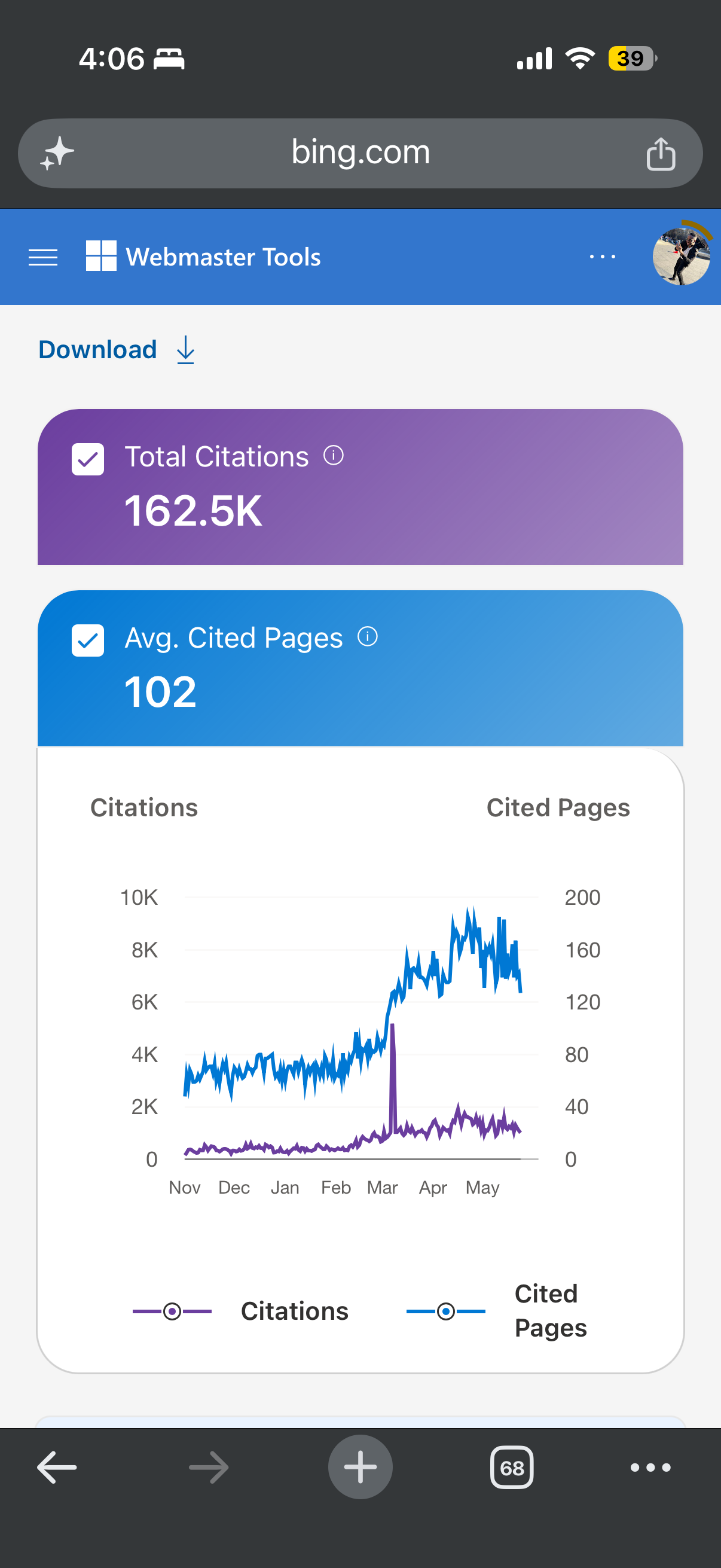
That site has now been cited more than 162,500 times by Microsoft Copilot, with over 112,500 of those in just the last three months, alongside more than 5,000 Google clicks a day. The acceleration was not luck and it was not about me being a baking expert, because I am not one. It came from building the pages to be the thing AI reaches for. If it works in a niche where I personally have zero credibility, it works far more easily for you, in the niche where you are actually the expert.
What it means to be built for AI to quote
So what does "built to be recommended" actually mean? At the highest level it comes down to four things working together: one definitive answer for the main question in your niche, a tight set of supporting pieces that prove you have covered the whole topic, clear signals that tie all of it to a real, named human expert, and original material that only you could have written so the AI cannot summarize you away and skip you.
That last one is the quiet key. AI can paraphrase generic advice from anywhere, so generic advice never gets cited. What it cannot fabricate is your actual experience: the patterns you have seen across real clients, the framework you built, the numbers from your own work. That is the thing that forces an AI to point at you by name instead of absorbing your words into a faceless summary.
I am not going to cram the entire system into this post, because it deserves the full walkthrough. I wrote that out step by step in The Citation Cluster Method, which is the complete how-to. If you want to see it proven post by post on a real site, the case study on 144,321 AI citations in a quarter walks through the structure. The point I want you to leave with here is simpler than any tactic: being recommended by AI is something you build on purpose, not something you wait and hope for.
Where you actually stand right now
Here is the uncomfortable first step, and also the easiest one. Before you change anything, you should find out what the AI already says when someone asks about a business like yours. Most owners have genuinely never looked. They assume they show up, or they assume they do not, and both guesses are usually wrong.
You can see it for yourself in about three minutes. The free AI Visibility Check asks the AI engines the kinds of questions your buyers actually ask and shows you, in plain language, whether you get named or skipped, and who is getting named instead of you. It is the same first move I make with every business I work with, because you cannot fix a gap you have not measured.
The shift is real, it is already proven at the scale of the biggest companies alive, and it has not finished reaching your corner of the market yet. That is not a reason to feel behind. It is a short, closing window to get ahead. The businesses AI recommends a year from now are being decided right now, by who gets built for it first. You can be one of them, and the first step is just looking.